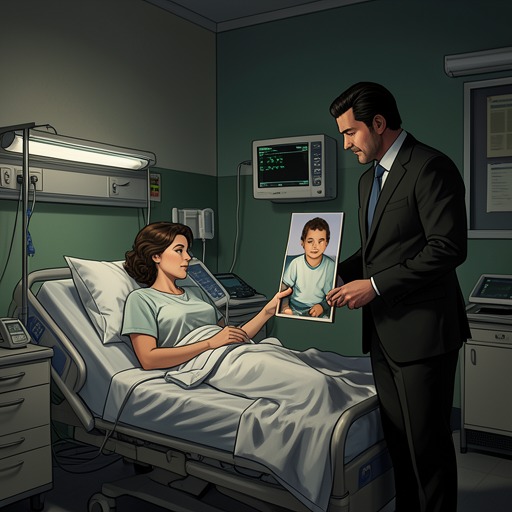
Kathy Hamilton
The Birthday PartyKathy Hamilton is a working mother whose family’s public respectability conceals a marriage in crisis, long-buried grief, and a history of choices made for her by others. When Charlie disappears, Kathy’s guilt over missing the birthday party draws her into the search; the secrets uncovered there reunite her with her first daughter, Megan Carter, and force her to confront the family pattern she wants to break.
Identity and Family Life
At the beginning of the story, Kathy lives in Maple Falls, Vermont, with her husband, Mitch Hamilton, and their five-year-old daughter, Charlie Hamilton. Her teenage daughter, Fay Hamilton, is also part of the household. The family’s ordinary summer routines unfold against Kathy’s private strain: on a hot morning, she feels a migraine beginning as she looks at Charlie’s sunlit blonde hair. When Mitch leans in to kiss her, Kathy offers her cheek instead. She still loves him, but a kiss on the lips feels too intimate, and his disappointment leaves her feeling at fault.
Kathy and Mitch are already attending marriage counseling, but Kathy doubts it is helping. She feels emotionally numb and fears their relationship will end in tears and public scrutiny. Their difficulties exist alongside the practical demands of her life: she works full-time, cares for the children, and feels responsible for commitments beyond the home. The strain is not simply private unhappiness; it shapes how she responds when the family is put under pressure.
Charlie’s Disappearance and Kathy’s Guilt
On the Saturday Charlie disappears, Kathy says the family had breakfast together before Mitch left for work shortly after nine. Kathy was meant to go to the women’s refuge, but instead stayed home alone for a few hours because she had a migraine and needed to rest before the party. She later explains that the music and afternoon sun made the migraine worse. She had not told the police that she missed the refuge, and when Detective Chase Cooper presses the family about its movements, she fears the omission will be judged as evidence against her.
Kathy eventually admits what happened. She explains that she felt expected to manage everything, that Mitch was rarely home, and that she had felt guilty for letting the refuge staff down. The hours of quiet had felt like a rare chance to recover, but the relief becomes inseparable from remorse once Charlie is missing. Kathy says she would have stayed at the party had she known Charlie would be abducted. Her confession also exposes a burden she has been carrying: she believes she should have been able to meet every responsibility, even when she was exhausted and unwell.
The next morning, reporters gather outside as the search continues. Kathy had planned to take Charlie shopping for vacation clothes, eat at her favorite diner, and let her have an ice-cream sundae she had often refused because of concerns about Charlie’s teeth. Now she regrets every refusal. Unable to sleep because she expects to become a headline for misleading the police, Kathy spends the night in Charlie’s room. Mitch joins her there; without recriminations, they cry and pray for Charlie to return, eventually falling asleep holding each other. Their shared grief briefly brings them close even as their marriage remains troubled.
A Mother to Charlie and Megan
Kathy’s relationship with Megan begins under the shadow of Mitch’s affair with her. When Megan arrives at the house with Mitch, Kathy asks her parents not to stare at Megan’s bruises or head wound, and later apologizes for not taking better care of Charlie on the day of the party. She tells Megan that Charlie is welcome in her home regardless of whether Kathy and Mitch save their marriage, and extends that welcome to Megan as well. Megan responds that Charlie loves the Hamilton family and has been happy living with them, but insists they must take action themselves rather than simply wait for the police or Mitch to find her. Kathy agrees: waiting for news feels unbearable.
That exchange reveals the difference between biological and lived motherhood in Kathy’s life. Charlie is her adopted daughter, and Kathy loves her as a member of the family; Megan, whom Kathy first encounters as a woman connected to Mitch, is in fact the daughter she lost as a teenager. Kathy learns this when Megan tells her that Susan Cartwright found the name of her birth mother: Kathy. Megan also reveals her birth name, Hope Hamilton. The recognition turns an already painful search into a reunion shaped by both love and the years they were kept apart.
The Past Behind the Family Secrets
Kathy was seventeen when she became pregnant with her first child. She had trusted the person involved and had rarely allowed herself to speak about the experience. Her mother, Connie Hamilton, made her give the baby up because she could not accept her daughter raising a child born outside marriage and feared what people, including her church acquaintances, would say. Kathy later learns that Connie would have allowed her to keep the baby if the child had been a boy, because a son could carry on the Hamilton name. The unequal standard makes plain that family reputation mattered more to Connie than Kathy’s choice or the child’s future.
Kathy’s first daughter was adopted and raised as Megan Carter, later identified as Hope Hamilton. Kathy’s reunion with her makes the consequences of the earlier secrecy immediate: a decision made to protect the family’s standing shaped both women’s lives. Kathy tells Megan about the forced adoption, and eventually explains to Chase that she would never have opened up about the past, or come to know Megan properly, if Charlie had not been taken. She sees Charlie’s disappearance as the crisis that brought the separated parts of her family back into contact.
The past also reaches into Kathy’s marriage and relationship with Chase. Kathy tells her mother that if Connie had allowed her to be with Chase at the hotel, she would not have slept with her therapist, Evan Harris. She describes Harris as someone who violated the trust inherent in that relationship. The revelation reframes what Kathy had kept hidden for years: rather than treating the episode as an isolated private shame, the story places it within the power imbalance of a therapist-client relationship and the pressure exerted by her family.
Breaking the Cycle and Choosing a Future
As the family confronts its history, Kathy recognizes a pattern between her childhood and Fay’s distress. Her therapist had connected Kathy’s food-related difficulties to the arguments she witnessed between her parents. Kathy now wonders whether her choice to remain in a troubled marriage and conceal Mitch’s affair helped leave Fay with a similar burden. She does not treat the comparison as proof that she caused Fay’s anxiety, but as a warning about the damage that family conflict and silence can pass on. Seeing the resemblance, she resolves to do better and break the cycle.
That resolve is tested when Connie’s role in the plot against Megan and Charlie comes to light. Kathy realizes that Connie advised Evan Harris to eliminate the problem, and understands the apparent reward for information about the missing girls as an offer Connie believed would never have to be claimed. Kathy also recognizes that Connie intended Mitch to be framed, potentially leaving him to face punishment for crimes he had not committed. In this confrontation, Kathy sees both the betrayal of her daughters and the way her mother’s control had shaped the family for years. Her father, Jack, has reached his own limit with Connie’s behavior; Kathy’s view of him softens as she recognizes that he, too, has lived under Connie’s control.
After Charlie’s death, the family visits her grave. Mitch tells Kathy that Charlie was lucky to have her as a mother, and Megan is grateful to have a place where she can come and speak about Charlie. Kathy then proposes changing her surname to Carter. Fay likes the idea of becoming Fay Carter and has already said she does not want to remain a Hamilton. Mitch, too, is ready to leave the Hamilton name and return to Bowers; he has moved out to his own place, with a spare room where Fay can stay. These are stated intentions and plans, not a completed change of name. They nevertheless mark a collective rejection of the prestige and secrecy Connie defended, and Kathy’s effort to define family through care, honesty, and choice rather than inherited reputation.